A Short History of AI: From Logic Engines to Thinking Agents
Welcome to aibyexamples.com! If you've ever wondered how we leaped from clunky room-sized computers calculating ballistic trajectories to pocket-sized devices writing poetry and generating code, you're in the right place.
Artificial Intelligence is not a single overnight invention. It is an epic, decades-long relay race of breakthroughs, crashes, and paradigm shifts. Let’s step into the shoes of the pioneers who paved the way.
🎮 Stage 1: The Playground — The Chrono-Engineer's Vault
Imagine you are a Chrono-Engineer tasked with restoring humanity's historical archives. A timeline anomaly has scrambled three legendary artifacts into the wrong time periods.
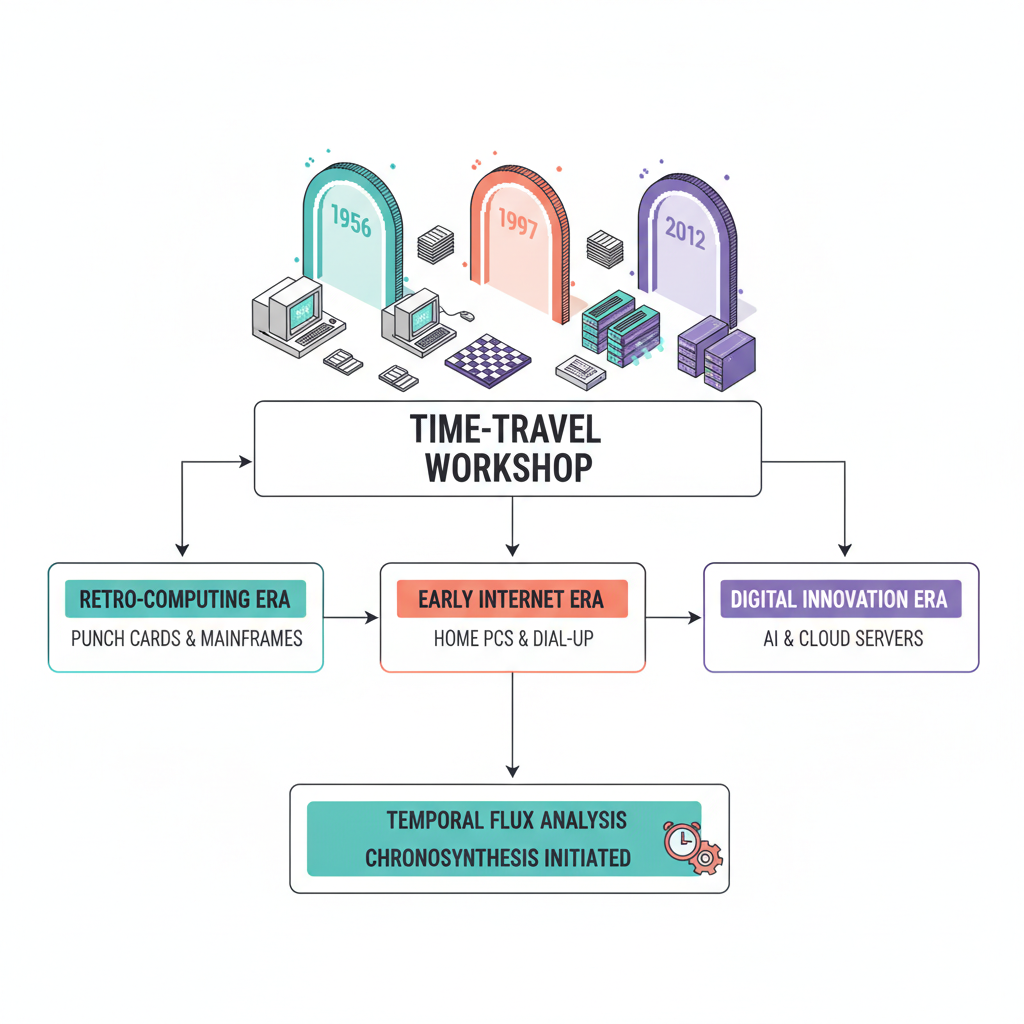
The Objective
Match each iconic artifact to its correct historical era to re-open the Chrono-Vault:
- Artifact A: A room-sized mainframe running an algorithm that manually hand-codes thousands of
IF/THENlogic statements to diagnose infectious blood diseases. - Artifact B: A desktop workstation using specialized graphics cards (GPUs) to scan millions of labeled internet photos, learning by itself what a "cat" looks like without a single human-written rule.
- Artifact C: A customized IBM supercomputer capable of calculating 200 million chess positions per second to defeat reigning World Chess Champion Garry Kasparov.
The Rules of Play
- Era 1 (The Symbolic Age): Compute is rare. Humans write the rules; machines simply execute the logic.
- Era 2 (The Statistical Turn): Compute is growing. Machines crunch probabilities and search trees over vast, well-defined problem spaces.
- Era 3 (The Deep Learning Revolution): Compute is massive. Machines learn representations and patterns directly from raw, uncurated data.
🗺️ Stage 2: Concept Blueprint & Mind Map
To understand how we arrived at today's generative models and autonomous agents, we divide the history of AI into four major evolutionary waves:
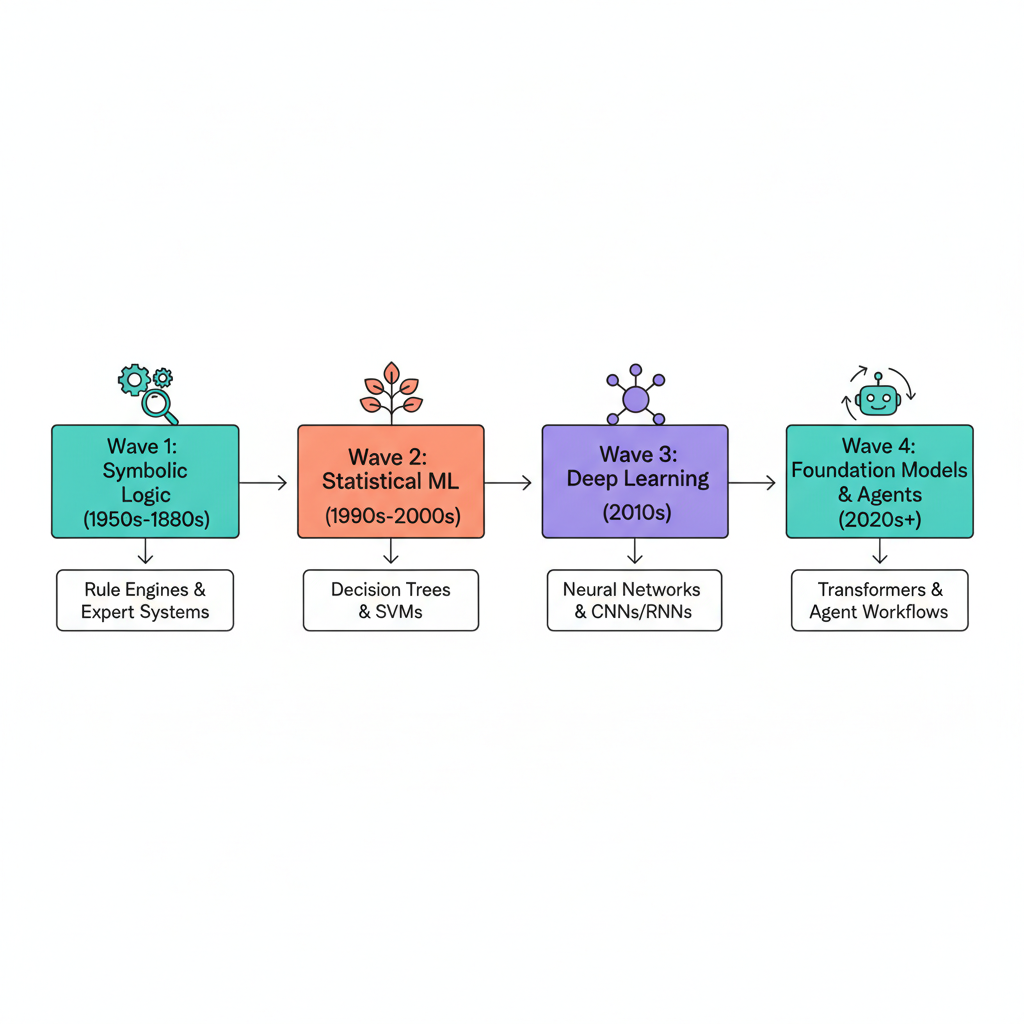
[1950s - 1980s] Wave 1: The Rulecrafters (Symbolic AI)
   ├── Core Paradigm: Logic, deduction, and expert systems
   └── Bottleneck: Brittleness; humans had to hard-code every edge case.
          │
          ▼
[1990s - 2000s] Wave 2: The Pattern Hunters (Statistical ML)
   ├── Core Paradigm: Probabilities, feature engineering, support vector machines
   └── Bottleneck: Manual feature extraction; models struggled with unstructured data.
          │
          ▼
[2010s] Wave 3: The Deep Miners (Deep Learning)
   ├── Core Paradigm: Multi-layered Neural Networks, Backpropagation (the feedback mechanism that tunes weights backwards from error signals), Big Data (ImageNet), GPUs
   └── Bottleneck: Opaque "black boxes"; requires immense computational energy.
          │
          ▼
[2020s - Present] Wave 4: Autonomous Synthesizers (Foundation Models & Agents)
   ├── Core Paradigm: Transformers, self-supervised pretraining, multi-agent orchestration
   └── Bottleneck: Hallucinations, alignment, context window limits, agency governance.
Component Breakdown
[Paradigm: Symbolic AI](Deductive): . You tell the machine the rules of the world; it deduces answers.[Paradigm: Machine Learning](Inductive): . You show the machine input/output examples; it calculates the underlying function.[Paradigm: Foundation Models](Generative/Agentic): . The machine builds a unified world model and uses tools to plan and execute multi-step goals.[Phenomenon: AI Winter]A period of dramatic funding cuts and skepticism caused by overpromising and underdelivering on machine capabilities (historically mid-1970s and late-1980s).
✏️ Stage 3: Interactive Activity — The Paradigm Matrix
Can you identify which historical paradigm matches the real-world problem-solving approach? Complete the table below by filling in the blanks.
The Challenge Table
| Historic System | Primary Era | Input provided to Machine | What the Machine did | Fatal Bottleneck |
|---|---|---|---|---|
| MYCIN (1970s) | Wave 1 | Patient symptoms + Medical rules | Evaluated logic tree | [ ??? - Blank 1 ] |
| Spam Filter (1990s) | Wave 2 | Word count vectors + Spam tags | [ ??? - Blank 2 ] | Tricked by misspelled words |
| AlexNet (2012) | Wave 3 | Millions of raw pixels | Learned hierarchical visual features | High GPU compute cost |
| Autonomous Tool-Using Agent (e.g., ReAct) (2024) | Wave 4 | Goal prompt + Web tools | [ ??? - Blank 3 ] | Susceptible to prompt injection |
💡 Click to Reveal Solution & Walkthrough
Completed Solution
- Blank 1: Brittleness / Scaling failure. (Doctors could not manually write rules for every rare medical exception; the system could not handle ambiguous or conflicting data.)
- Blank 2: Calculated Bayesian probabilities / Statistical weights. (Counted how often words like "VIAGRA" appeared in spam vs. inbox.)
- Blank 3: Decomposed instructions into sub-steps, executed tools, and synthesized output.
(Historical Note: In 1969, Minsky and Papert proved that single-layer perceptrons could not solve the simple non-linear XOR gate function—a mathematical bottleneck of non-linear separability that contributed directly to triggering the first AI Winter.)
Chrono-Engineer Vault Answers from Stage 1:
- Artifact A (MYCIN / Expert System) Era 1 (1956–1980s)
- Artifact C (Deep Blue) Era 2 (1997)
- Artifact B (AlexNet / CNNs) Era 3 (2012)
⚙️ Stage 4: "Under the Hood" Mechanics
Why did AI take nearly 70 years to reach the capabilities we see today? The evolution of AI is governed by The Rule of 3 (The Iron Triangle of AI Evolution):
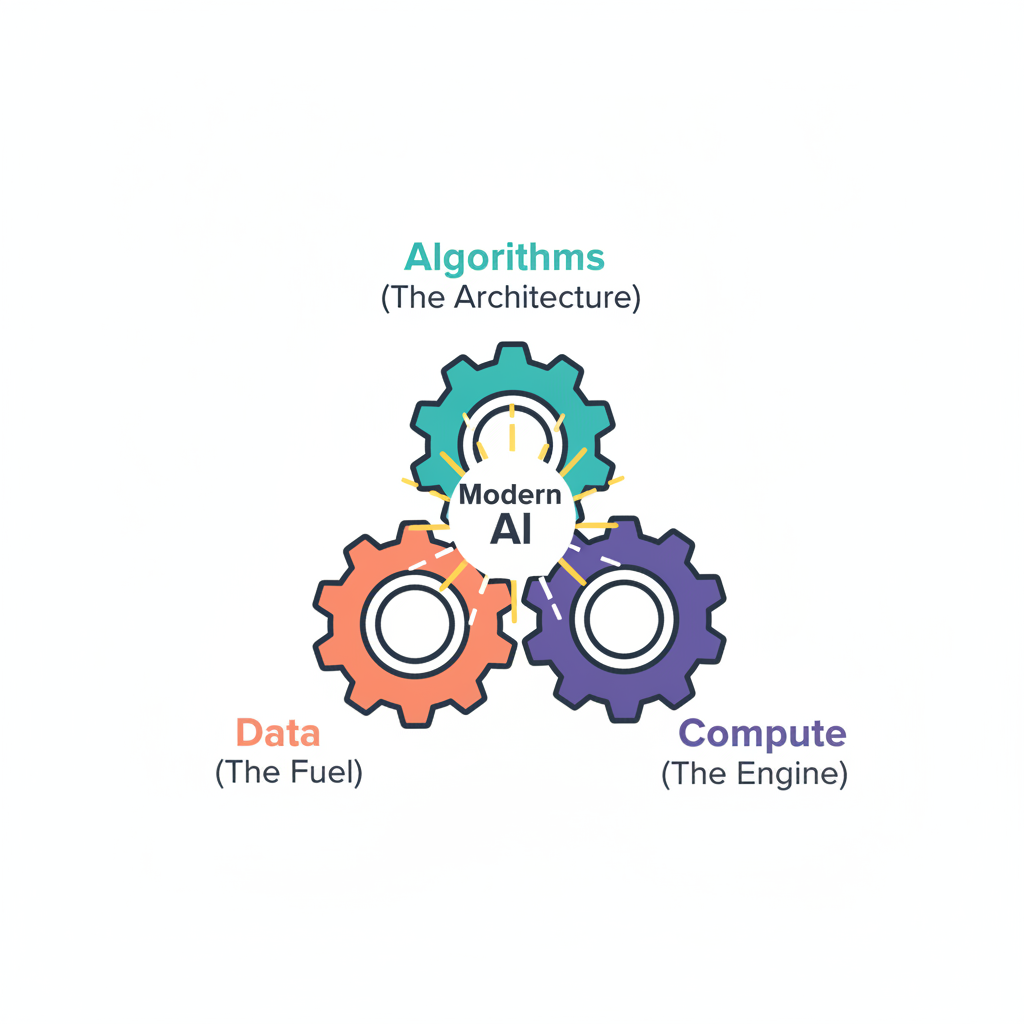
               [ Compute ]
             (CPUs -> GPUs -> TPUs)
                   /\
                  /  \
                 /    \
                /  AI  \
               / Breakthrough \
              /________\
    [ Algorithms ]     [ Data ]
(Backprop, Transformers) (Web Text, ImageNet)
Behind the scenes, every historical leap happened only when all three gears clicked simultaneously:
1. Algorithms (The Blueprint)
The math behind deep neural networks—specifically backpropagation (the feedback mechanism that tunes neural network weights backwards from error signals)—was popularized in 1986 by Rumelhart, Hinton, and Williams. However, running backpropagation on a 1986 computer took days to learn even tiny patterns. The blueprint existed, but the engine was missing.
2. Data (The Fuel)
Before the internet, data was scarce and had to be transcribed by hand onto punch cards. In 2009, Fei-Fei Li created ImageNet, labeling 14 million images. For the first time, machine learning models had enough fuel to generalize without overfitting.
3. Compute (The Engine)
In 2012, researchers realized that Graphics Processing Units (GPUs)—originally built to render video game graphics—were mathematically optimized for matrix multiplication. AlexNet trained on two NVIDIA GTX 580 gaming graphics cards, slashing training time from months to days.
When statistical and neural models make decisions, mathematically they compute:
(In plain English: is the model's final prediction, and simply means "select the class label that received the highest calculated score or probability given input ").
This convergence exemplifies The Bitter Lesson (formulated by AI researcher Rich Sutton): the principle that general search and learning methods scale far better with massive compute than handcrafted human heuristics and domain rules.
🛠️ Stage 5: The Micro-Sandbox — 3 Eras in 30 Lines of Code
Let's witness the paradigm shift directly in code! We will solve the exact same task—Classifying User Intent—using methods from Wave 1 (Symbolic Rules), Wave 2 (Statistical Probabilities), and Wave 4 (Semantic Embeddings).
(Note: We bridge from Era 2 directly to conceptual Era 4 vectors to keep this sandbox strictly zero-dependency in standard Python, avoiding external deep learning libraries like PyTorch or TensorFlow).
Run this self-contained Python script to see how each era approaches intelligence:
import math

# Task: Determine if a user input is a "GREETING" or an "ACTION_REQUEST"
query = "Hey there, can you please shut down the server?"

# =====================================================================
# ERA 1 (1970s): The Symbolic Expert System
# Paradigm: Strict human-coded Boolean logic
# =====================================================================
def era1_symbolic_ai(text: str):
    # Human engineers hard-code every possible rule
    tokens = text.lower().replace("?", "").replace(",", "").split()

    # Brittleness alert: If the greeting contains an action, logic easily conflicts
    if any(word in ["hello", "hi", "hey"] for word in tokens):
        return "GREETING", {"matched_rule": "greeting_keyword"}
    elif any(word in ["shutdown", "delete", "run", "shut"] for word in tokens):
        return "ACTION_REQUEST", {"matched_rule": "action_keyword"}
    return "UNKNOWN", {"matched_rule": "none"}

# =====================================================================
# ERA 2 (1990s): The Statistical Classifier (Naive Bayes Style)
# Paradigm: Learning word frequency probabilities from past data
# =====================================================================
def era2_statistical_ai(text: str):
    # Pre-calculated log-likelihood weights learned from historical training data
    # (Higher score = stronger statistical correlation to that class)
    vocab_weights = {
        "hey":      {"GREETING": 2.5, "ACTION": 0.1},
        "shut":     {"GREETING": 0.0, "ACTION": 3.2},
        "server":   {"GREETING": 0.0, "ACTION": 2.8},
        "down":     {"GREETING": 0.0, "ACTION": 1.9}
    }

    scores = {"GREETING": 0.0, "ACTION": 0.0}
    for word in text.lower().replace(",", "").replace("?", "").split():
        if word in vocab_weights:
            scores["GREETING"] += vocab_weights[word]["GREETING"]
            scores["ACTION"] += vocab_weights[word]["ACTION"]

    prediction = "ACTION_REQUEST" if scores["ACTION"] > scores["GREETING"] else "GREETING"
    return prediction, scores

# =====================================================================
# ERA 4 (2020s): Semantic Similarity (Vector Geometry)
# Paradigm: Unsupervised high-dimensional conceptual space
# =====================================================================
def era4_modern_vector_ai(text: str):
    # Toy vector embeddings representing conceptual dimensions: [Social/Polite, Directive/System]
    prototype_vectors = {
        "GREETING": [0.95, 0.05],
        "ACTION_REQUEST": [0.10, 0.90]
    }

    # Simulated embedding extraction from a modern language model
    # Notice how it understands that "shut down the server" dominates the true semantic intent
    query_vector = [0.30, 0.85]

    # Cosine Similarity measures directional alignment in vector space
    # (1.0 = identical meaning, 0.0 = completely unrelated)
    def cosine_similarity(v1, v2):
        dot = v1[0]*v2[0] + v1[1]*v2[1]
        mag1 = math.sqrt(v1[0]**2 + v1[1]**2)
        mag2 = math.sqrt(v2[0]**2 + v2[1]**2)
        return dot / (mag1 * mag2)

    sim_greeting = cosine_similarity(query_vector, prototype_vectors["GREETING"])
    sim_action = cosine_similarity(query_vector, prototype_vectors["ACTION_REQUEST"])
    scores = {"GREETING_SIM": round(sim_greeting, 3), "ACTION_SIM": round(sim_action, 3)}

    prediction = "ACTION_REQUEST" if sim_action > sim_greeting else "GREETING"
    return prediction, scores

# --- EXECUTION ---
print(f"Input query: '{query}'\n")

pred1, meta1 = era1_symbolic_ai(query)
print(f"Era 1 (Symbolic) Result    : {pred1} (Rule: {meta1['matched_rule']})  <-- (Fails due to keyword collision!)")

pred2, meta2 = era2_statistical_ai(query)
print(f"Era 2 (Statistical) Result : {pred2} (Scores: GREETING={meta2['GREETING']}, ACTION={meta2['ACTION']})  <-- (Resolves based on aggregated frequency)")

pred4, meta4 = era4_modern_vector_ai(query)
print(f"Era 4 (Modern Vectors) Result: {pred4} (Similarities: {meta4})  <-- (Captures holistic context)")
⚡ Modify This Challenge
- Change the query to:
"Good morning, what a lovely day!" - Predict what Era 1 will output before running it. Why does it output
UNKNOWN? - Add
"good"and"morning"to Era 1's rulebook, and observe how manual rule creation quickly becomes unmaintainable.
🧠 Stage 6: Reflection & "What If?" Audit
Test your understanding of historical trade-offs with these three architectural audits:
Scenario 1: The Infinite Knowledge Trap
- The Pitch: An enterprise startup proposes reviving 1980s Expert Systems by hiring 10,000 domain experts to write 50,000,000
IF-THENrules to compete with modern Large Language Models. - The Audit Question: Why will this project fail even with infinite funding?
- Hint: Reflect on The Bitter Lesson (why general learning methods beat manual rules) along with combinatorial explosion and contradictory edge cases in human language.
Scenario 2: The Data Saturation Wall
- The Pitch: Modern frontier AI labs have consumed almost all publicly available human text on the internet to train foundation models.
- The Audit Question: Based on the "Rule of 3" (Compute, Data, Algorithms), what will happen if Compute continues to scale 10x per year, but human-generated Data stops growing? Where must the next architectural shift occur?
Scenario 3: The 1974 Winter Deja Vu
- The Pitch: During the first AI Winter (1974), the British Lighthill Report concluded that AI had failed because combinatorial complexity rendered toy problems useless in the real world.
- The Audit Question: What is the modern equivalent risk for today's Autonomous Agents? Could hallucination rates and unbounded reasoning loops trigger a specialized "Agent Winter"?
What's Next?
Now that you understand the historical shifts—from hard-coded rules to statistical learning, neural representations, and modern agents—you are ready to build them. In the next tutorial, we will dive deep into Machine Learning Fundamentals: Teaching Machines to Learn from Loss.